Why Is My Boiler Losing Pressure?
Why Is My Boiler Losing Pressure? Here’s What’s Probably Going On
You glance at the boiler pressure gauge one morning and suddenly realise the needle has dropped again. Brilliant. Another household mystery nobody asked for.
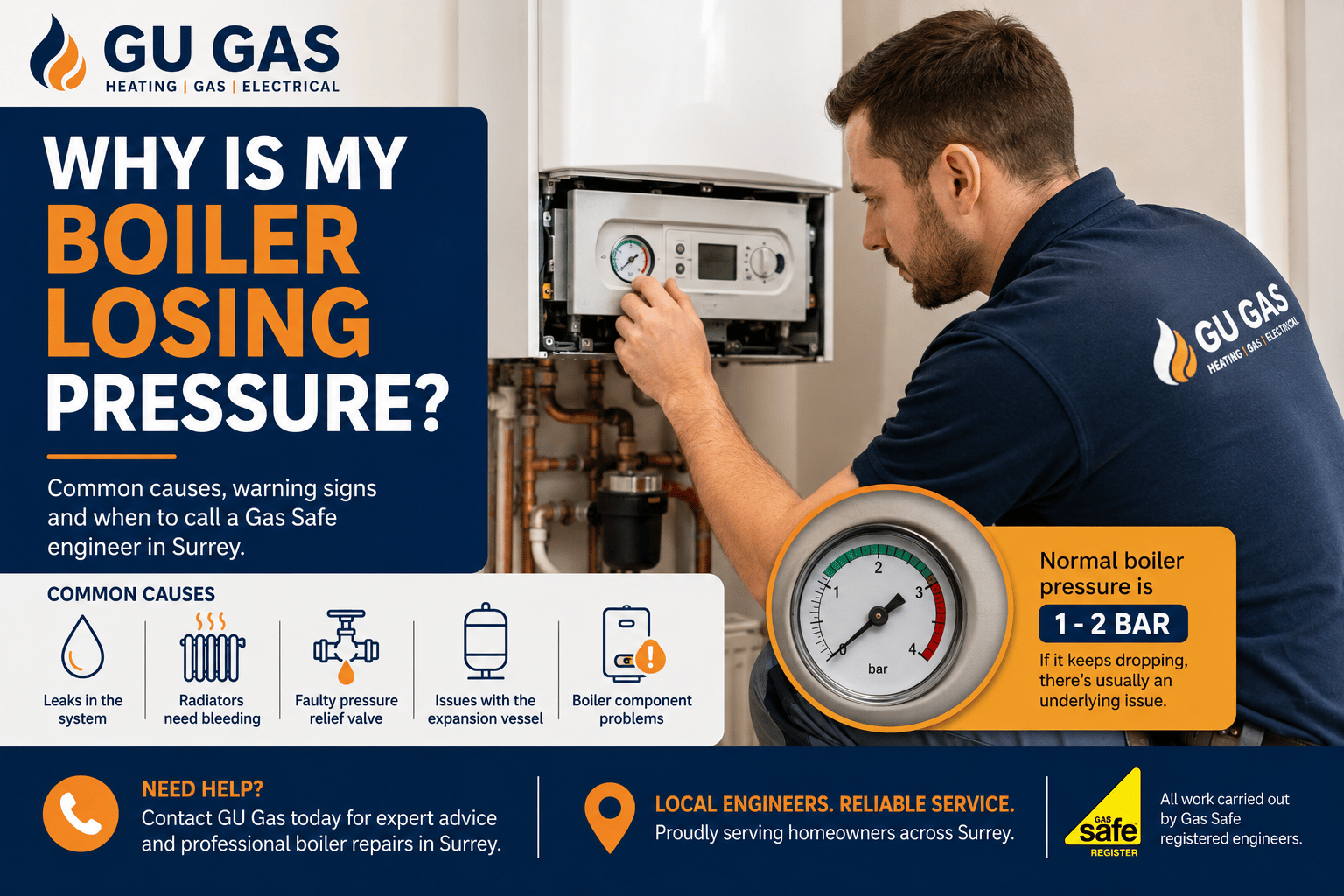
If you’re wondering why is my boiler losing pressure, don’t panic just yet. It’s one of the most common boiler issues we see at GU Gas, especially during colder months when heating systems are working overtime.
Sometimes the fix is simple. Other times, your boiler is basically waving a tiny mechanical white flag asking for help. Either way, understanding why your boiler is losing pressure can help you spot problems early and avoid bigger repair bills later.
First Things First – What Boiler Pressure Actually Does
In a sealed heating system, the gauge shows the pressure of the water circulating through the heating circuit. It does not measure the incoming mains pressure at your taps. Low system pressure can prevent the boiler operating normally; pressure behaviour needs interpreting for the particular installation.
Check the boiler manufacturer instructions for the recommended reading and whether it should be measured cold. Pressure normally changes as the heating water warms and cools; do not apply one fixed range to every boiler or operating condition.
1. There’s a Leak Somewhere
Water escaping from the heating circuit is one possible cause of pressure loss. It may be visible or concealed, but a falling gauge alone does not establish where the problem lies.
Now before you start imagining Niagara Falls pouring through your kitchen ceiling, leaks are often tiny and hard to spot. A small drip from a radiator valve, pipe joint or hidden section of pipework can slowly reduce system pressure over time.
Signs to look for include:
- Damp patches near radiators
- Staining on ceilings or walls
- Puddles near the boiler
- Radiators needing frequent bleeding
Even a tiny leak can cause ongoing pressure loss if ignored. Our boiler repair service explains how we investigate pressure loss and discuss the work needed.
2. Your Radiators Have Been Bled Recently
If you’ve recently bled your radiators, that could explain why your boiler is losing pressure.
Bleeding a radiator can reduce pressure in a sealed system. Any permitted repressurising must follow the specific appliance instructions; ask an engineer if you are unsure. An initial change after bleeding is different from continuing pressure loss.
If you’re constantly needing to repressurise the system though, there’s likely another issue lurking underneath.
3. The Pressure Relief Valve Is Letting Water Out
Your boiler has a safety feature called a pressure relief valve (PRV). If the system pressure gets too high, the valve opens to release excess water.
Sounds sensible, right? The problem comes when the valve gets faulty or stuck slightly open.
Water may escape through the safety discharge pipe if the relief valve does not close correctly or system pressure has risen too high. Dripping does not by itself prove the valve is the original fault. Do not confuse this discharge with normal condensate drainage or block either pipe.
4. The Expansion Vessel Has Lost Its Charge
Now we’re entering “slightly more technical but still fixable” territory.
The expansion vessel accommodates changes as the heating water warms. Loss of its charge or a damaged internal membrane can affect pressure control. These are matters for professional assessment, not a reason to recharge or open components yourself.
When this happens, you may notice:
- Pressure dropping regularly
- Boiler pressure rising rapidly when heating is on
- Pressure relief pipe dripping outside
If this sounds familiar, it’s time to call a professional.
5. A Problem With the Boiler Itself
Sometimes the issue is internal. Faulty seals, worn components or corrosion inside the boiler can all contribute to pressure loss.
The appliance condition and service history can help guide the investigation, but age alone does not diagnose an internal leak. Report noises, shutdowns or poor heating alongside pressure loss rather than assuming every symptom has the same cause.
Is the pressure falling quickly or gradually?
A boiler losing pressure quickly needs the change investigated, particularly if water is visibly leaking or the appliance stops working. A slow fall over days can also reflect a leak or component issue; the rate alone cannot identify the fault. Do not keep running or refilling a system with an unexplained leak.
Note whether pressure rises markedly during heating, then falls when cold, or continues falling while the heating is off. Expansion-vessel problems can contribute to a rise and discharge as water heats, leaving a lower reading afterwards. Loss while off may still involve a leak or valve issue. These patterns are useful observations for the engineer, not a diagnosis by themselves.
Can I Fix Boiler Pressure Myself?
Keep homeowner checks to safe observations and the user instructions.
You can note the gauge reading, whether the heating is on or off, any fault code and visible damp without removing covers. Do not open the casing, interfere with gas components, operate safety valves or attempt internal repairs.
Repeatedly topping up a sealed system is not a repair. Persistent pressure loss needs investigation rather than continuing to add water or repeatedly reset the appliance.
If you’re repeatedly asking yourself why is my boiler losing pressure, it’s time to stop resetting it and start investigating properly.
When Should You Call a Gas Engineer?
You should call a professional if:
- The pressure keeps dropping
- You can see leaks
- Your boiler shuts down regularly
- You hear banging or gurgling noises
- You’re unsure how to repressurise safely
At GU Gas, we investigate domestic boiler and heating faults in Woking and within five miles. The findings, access and suitable parts determine the repair options; a short visit or particular outcome should not be assumed.
Routine maintenance and repairs are different
Planned boiler servicing follows the appliance maintenance requirements and may identify concerns. It is not a substitute for investigating an existing leak or repeated pressure loss, and should not be assumed to include the required repair.
If your home also includes electrical upgrades or appliance work, it’s worth making sure the whole system is working safely together. Our guides on professional electrical service and consumer unit installation can help you understand the bigger picture.
Why Is My Boiler Losing Pressure After I Top It Up?
If you top up the pressure and it drops again within days, that usually means the problem has not gone away. This is one of the biggest signs that something needs checking properly.
So, why is my boiler losing pressure after being refilled? It could be a hidden leak, a faulty pressure relief valve, or an expansion vessel issue. The important thing is not to keep topping it up forever. That’s like putting air in a tyre with a nail in it. It might work for a bit, but it won’t fix the problem.
Is Low Boiler Pressure Dangerous?
A low reading can stop the boiler operating, but it does not establish whether the underlying fault is safe. Leaks near electrical parts, signs of overheating or a suspected gas leak require appropriate safety action rather than simply adding water.
If you suspect the appliance is unsafe, stop using it and seek professional advice. For a suspected mains gas leak, leave the property and call 0800 111 999 from a safe place; for LPG, contact the supplier emergency service. Avoid electrical switches and naked flames.
Can GU Gas Help?
GU Services can discuss the symptoms and proposed investigation for homes in Woking and within a five-mile radius. Share the model if known, service history and when the pressure changes.
If your heating keeps acting up and you’re repeatedly asking why is my boiler losing pressure, it’s always better to deal with the cause early rather than waiting for a complete breakdown in the middle of winter.
Any repair should follow the diagnosis. Ask what the proposed work includes, whether further investigation or parts are separate, and how additional findings will be explained before proceeding.
If pressure keeps falling, contact GU Gas with your postcode and observations to discuss assessment. Do not dismantle equipment to provide more information.
Final Thoughts
If you’ve been wondering why is my boiler losing pressure, the important thing is not to ignore it.
Pressure loss is your heating system’s way of telling you something isn’t quite right. Sometimes it’s minor. Sometimes it’s the early warning sign of a much bigger issue.
The cause, not just the gauge reading, should guide the next step.