Fuse Boards: What Homeowners Should Know
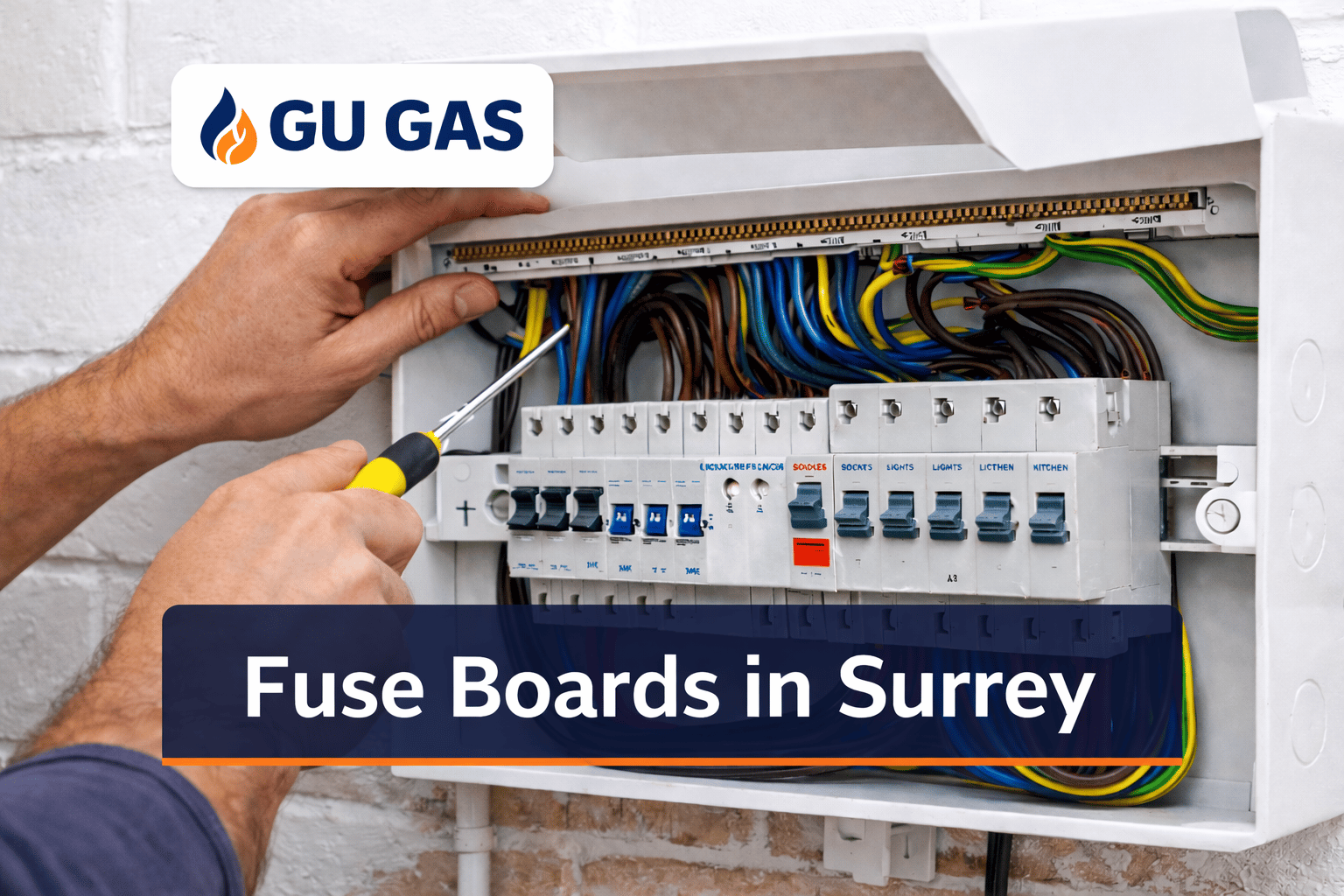
A fuse board, also called a consumer unit, distributes electricity to the circuits in your home and houses protective devices. This guide from GU Gas explains domestic fuse boards, signs that an inspection may be useful and how to approach an upgrade. GU Services serves residential properties in Woking and within five miles.
What are fuse boards and consumer units?
Traditional electrical fuse boards use fuses for overcurrent protection. Modern consumer units commonly use circuit breakers with residual-current protection and labelled circuits. The arrangement and condition need assessment: an older board does not automatically need replacement simply because newer equipment exists.
Circuit protection reduces particular electrical risks, but it cannot prevent every fault or injury. The connected wiring, accessories, earthing and bonding also matter. A new board cannot correct every defect elsewhere in the installation.
Signs a professional inspection may be appropriate
These are reasons to seek advice, not proof that a new board is the only solution:
- Older fuses or an installation whose condition is unknown.
- Repeated tripping after changes to appliances or normal use.
- Visible damage, scorching or a burning smell; do not touch the board to check its temperature.
- Intermittent loss of power on particular circuits.
- Planned alterations requiring an assessment of the supply and protection.
An Electrical Installation Condition Report (EICR) can help establish the installation's condition. For repeated tripping or a particular fault, electrical fault finding may be appropriate before deciding what work is needed.
Understanding protection and board arrangements
Circuit breakers protect against overcurrent. An RCD detects an imbalance that may indicate current leaking to earth and disconnects the protected supply. These devices perform different functions and need suitable selection and testing.
Some split-load boards divide circuits into groups protected by shared RCDs. A trip can interrupt several circuits in a group; do not assume every board has a fixed split between lighting and sockets. An RCBO combines residual-current and overcurrent protection for an individual circuit.
Board space, circuit requirements and compatibility affect the design. Fitting a larger board does not create extra capacity in the incoming supply.
Manufacturer information, such as the consumer-unit ranges from Crabtree and Lewden, can help identify equipment terminology. Mentioning Crabtree or Lewden fuse boards here does not mean GU Services supplies or installs those brands. Suitability and compatible devices need confirming for the installation.
What does 18th Edition mean for fuse boards?
The 18th Edition of BS 7671, the IET Wiring Regulations, sets requirements for electrical installation work, with amendments considered as applicable. A product advertised as an 18th Edition fuse board does not by itself establish that an entire installation complies. Design, compatible equipment, installation and testing all matter. Existing installations need assessment rather than automatic replacement whenever standards change.
Stay safe around live equipment
Do not work on live fuse boards or open a consumer unit. Incoming connections can remain live even with the main switch off, and other sources may be present. Leave isolation and internal work to a competent electrician. Do not repeatedly reset a tripping device or approach wet or damaged equipment; seek professional advice.
Fuse board installation: what to expect
When discussing an upgrade with GU Gas, share existing reports, known faults and planned changes to the home.
Assessment considers the supply, connected circuits, earthing and bonding, space and necessary remedial work. Agree the equipment, testing and documentation before work starts. Installation should include appropriate inspection, testing and circuit identification. Discuss access and the planned power interruption, including essential equipment that relies on electricity.
Safety testing and certification
An Electrical Installation Certificate records verification of new installation work, including a consumer unit replacement. It is different from an EICR on an existing installation. In England, replacement is notifiable Building Regulations work: agree the appropriate notification route and retain the separate compliance documentation as well as the electrical certificate.
Even if the board appears sound externally, inspection and testing may identify issues that are not visible at a viewing. Ask how findings will be explained and how additional work and costs would be agreed.
Frequently Asked Questions (FAQs)
Do I have to upgrade my fuse board?
Not automatically. Age, older fuses or differences from current standards are reasons to assess the installation, not a diagnosis. Condition, protective arrangements and the proposed work should guide the recommendation.
How long does a fuse board installation take?
The work and duration depend on access, the existing installation, testing and defects found. Discuss arrangements rather than assume a fixed completion time.
Will my power be off?
The relevant supply needs to be safely isolated during the work. Discuss the interruption and arrangements with the electrician before booking.
Planning the next steps
Gather available electrical records and describe any faults or planned alterations. Ask what the quote includes, how additional findings will be handled and which documents you will receive. Contact GU Gas with your postcode and requirements.
For a home in Woking or within five miles, explore our consumer unit replacement service to discuss assessment, upgrade options and the work your installation may need.